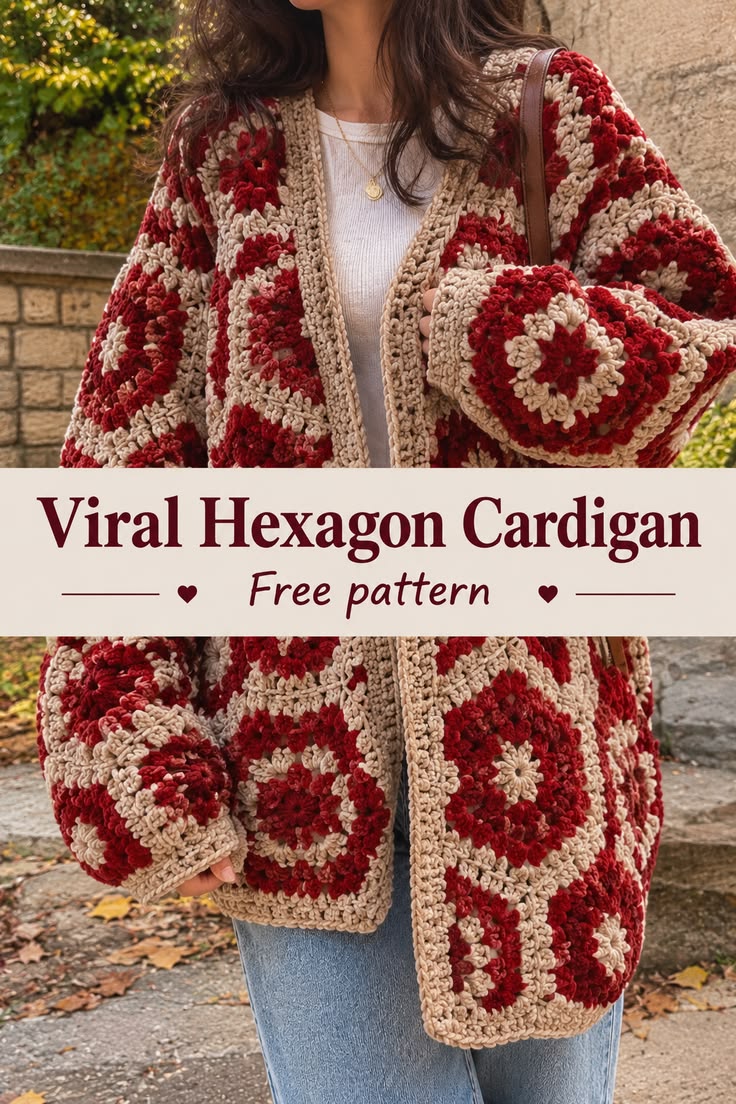

It is the cardigan that stops the scroll: two giant hexagons, worked in deep cherry red and warm oatmeal, folded and seamed into an oversized, slouchy, wear-it-everywhere cardigan. The hexagon cardigan has been crochet’s favourite magic trick for years — it looks like a complicated garment and is secretly one of the simplest constructions in the craft — and this cherry-and-oatmeal version is the colourway our Pinterest readers keep saving.
This post is a showcase of the design: how the two-hexagon construction works (in principle, not in steps), why the sizing is so forgiving, the colourways that make it sing, and where the free patterns for this classic design are published. The hexagon cardigan is a folk design with many free versions — the best-known are credited by name at the end.
Quick facts
| Design | Granny hexagon cardigan — the classic two-hexagon construction |
| Construction | Two identical granny-stitch hexagons, each folded into an L-shape, seamed at the centre back and shoulders |
| Skill level | Easy / advanced beginner — if you can work a granny cluster, you can make this |
| Sizing | Made to measure: you work rounds until the hexagon reaches your measurement (published free versions chart XS–5XL) |
| Yarn | Any weight works; the pictured look uses chunky yarn in 2 colours |
| Fit | Oversized and relaxed, with wide sleeves — part of the design, not a mistake |
| Pattern | Free versions published by several designers (see credits) |
The two-hexagon trick
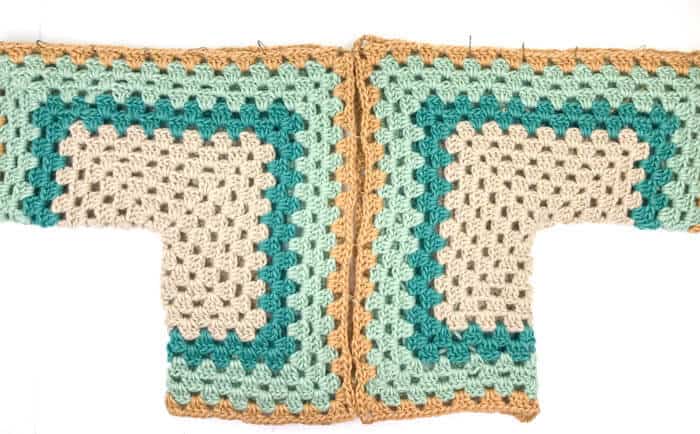
Here is the idea that made this cardigan famous. You crochet two large hexagons — six-sided versions of a granny square, worked in rounds of granny clusters. On their own they refuse to lie flat; they ruffle and ripple, and every beginner who tries this design has the same moment of panic. Then you fold one. The ruffled hexagon settles into an L-shape, and that L is suddenly half a cardigan: one front, half the back, and a sleeve, all in one piece. Fold the second hexagon the other way, seam the two halves down the centre back and across the shoulders, and a cardigan exists.
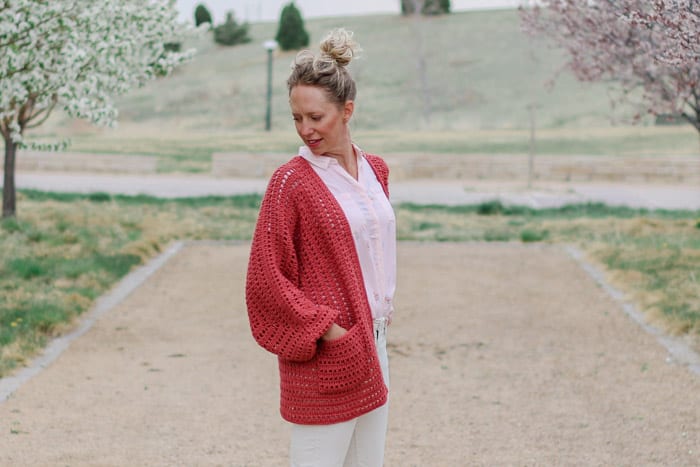
Because the garment grows out of the hexagon itself, extra width and length are added exactly where you want them — rows along the centre back, the fronts or the hem — without touching the sleeves. It is closer to a recipe than a rigid pattern, which is why this design has been re-taught by so many crocheters, most famously in HayHay Crochet’s tutorial, the version widely credited with sending the hexagon cardigan viral.

Why cherry and oatmeal works
The pin’s colourway does three smart things. First, only two colours: the hexagons alternate cherry red and oatmeal round by round, so the motif stays bold instead of busy. Second, the red is deep rather than bright — a cherry/berry red reads cosy and expensive where a scarlet can read costume. Third, the oatmeal is kept for the front bands and hem edging, framing the red pattern like a border on a picture and tying the whole cardigan together. Against a white top and jeans, it is a complete outfit from one handmade piece.
Other two-colour pairings in the same spirit:
- Forest green + cream — the woodland version, perfect with brown boots.
- Mustard + charcoal — moodier, very autumn.
- All one colour — a single oatmeal or stone shade turns the volume down and lets the hexagon texture do the talking.
- Scrap rounds — the made-to-measure versions were practically invented for leftovers; work each hexagon’s rounds in whatever you have, keeping the edging colour constant.
Materials — what this design uses
- Yarn of your chosen weight in 2 colours — the pictured look is a chunky/bulky yarn; DK gives a lighter, drapier cardigan (amounts depend on your size and yarn — the made-to-measure patterns explain how to estimate)
- A hook suited to your yarn
- Scissors, yarn needle for seaming, stitch markers
- A tape measure — sizing is by measurement, not by counting rows from a chart
Substitutions: this is the friendliest design in crochet for yarn swapping, because it is made to measure. Wool blends give structure and warmth; cotton blends give a cooler, heavier drape for spring. Whatever you choose, make both hexagons from the same yarn so they match when folded.
Abbreviations used in this design (US terms)
- ch — chain
- dc — double crochet
- cl — cluster (the 3-dc granny cluster this design is built from)
- sl st — slip stitch
Tips & variations
- Do not fight the ruffle. Hexagons that ripple are correct — they only lie flat once folded. If yours lies perfectly flat, it will not fold into the L.
- Fold and measure as you go. The fit check is literal: fold the hexagon, hold it against yourself, and decide whether to work another round.
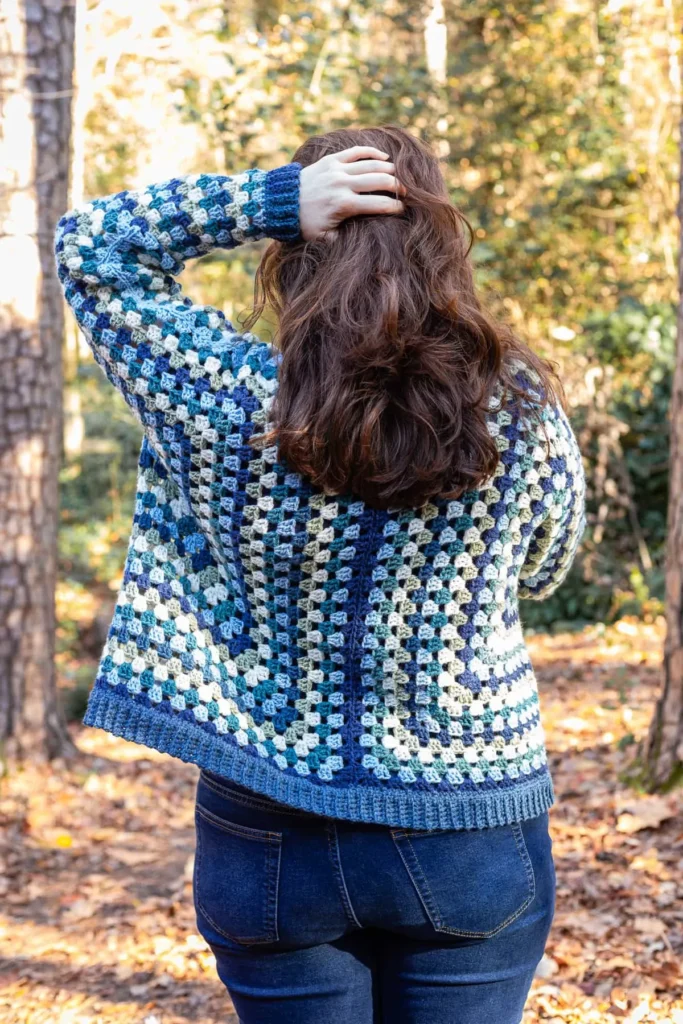
- Expect wide sleeves. The construction gives generous sleeves, and larger sizes get wider ones — that slouchy cuff is the signature look of this cardigan.
- Add length at the hem, width at the back. Extra rows go on the centre back, fronts and hem after seaming — not by making the hexagons bigger, or the sleeves grow too.
- Make both hexagons together. If you are using scraps or a limited dye lot, alternate rounds between the two hexagons so both end up identical.
FAQ
Is the hexagon cardigan pattern free?
Yes — this classic design is published free by several designers, including Craft and a Cuppa (a made-to-measure written pattern, XS–5XL) and Sarah Maker, and HayHay Crochet’s video tutorial is the version that made it famous. This showcase credits them by name; the patterns live on their own sites.
How many hexagons do I need?
Two. Each hexagon becomes half the cardigan — front, half-back and one sleeve — once it is folded into its L-shape and seamed.
Is it good for beginners?
It is one of the best first garments in crochet. If you can work a granny cluster and keep six corners per hexagon, you have every skill the cardigan needs.
How does the sizing work?
It is made to measure: you keep working rounds until half the hexagon matches the width you need, checking by folding as you go. Your yarn, hook and tension decide the round count, so no two makers’ cardigans use the same number.
Why does my hexagon ruffle instead of lying flat?
Because it is supposed to. The extra fabric is what lets it fold into a three-dimensional garment. Trust the fold.
Save it for your next garment
Save this pin for later — this is the cardigan you will want when the cold weekends land.
More to browse: our Modern Crochet Cardigan, the Journey to Hogwarts Blanket for more statement granny-style stitching, and the Granny Square Book Sleeve.
The hexagon cardigan is a classic folk construction. Free versions are published by HayHay Crochet (video tutorial), Craft and a Cuppa, Sarah Maker, Make and Do Crew (Campfire Cardigan) and Off the Beaten Hook (Elowen Cardigan). This post is a showcase — all pattern instructions live with the designers.
🧶 Get the Complete Pattern Book
Love patterns like this? We sell complete crochet pattern books — every book is just $1.89 right now (was $6.90).
📚 Browse the Pattern Books
 By